 |
 |
 |
 |
 |
 |
 |
 |
 |
 |
 |
 |
||||||||||||||||||||||||||||||||||||||||||||||||
| Replicating vesicles | || | Chemical replication of nucleic acids | || | Peptides in prebiotic chemistry |
|
Role of peptides in prebiotic chemistry |
||
|
Localizing RNA to membranes |
|
|
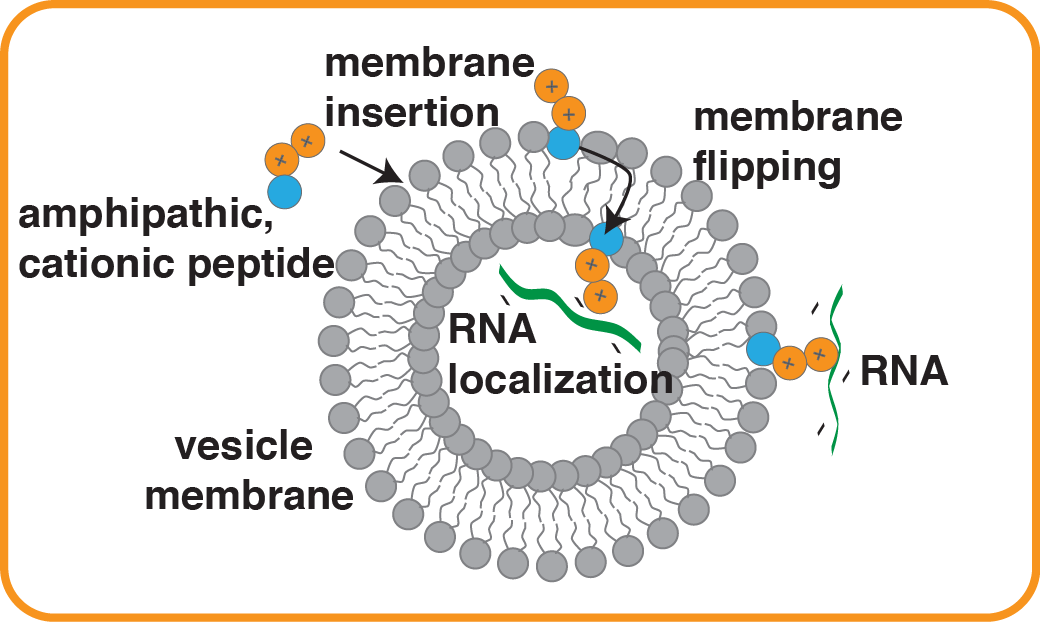
In primitive cells, membranes may have played a catalytic role by
co-localizing reactants on their surface. For example, the
localization of RNAs to membranes could promote ribozyme assembly
and facilitate ribozyme catalysis. Such a scenario relies upon a
simple mechanism to anchor the RNA onto the protocell membrane. Our
studies showed that short, cationic, amphipathic peptides can drive
RNA binding to both zwitterionic phospholipid and anionic fatty acid
membranes. The association of these cationic peptides with
phospholipid vesicles can enhance the local positive charge on a
membrane and attract RNA polynucleotides. This discovery opens the
door to studying membrane-localized prebiotic reactions with RNA
catalysts or substrates.
|
 |
|
Read more... Electrostatic localization of RNA to protocell membranes by cationic hydrophobic peptides. |
|
|---|---|---|
|
Assisting nonenzymatic RNA replication by slowing stranding annealing |
||
|
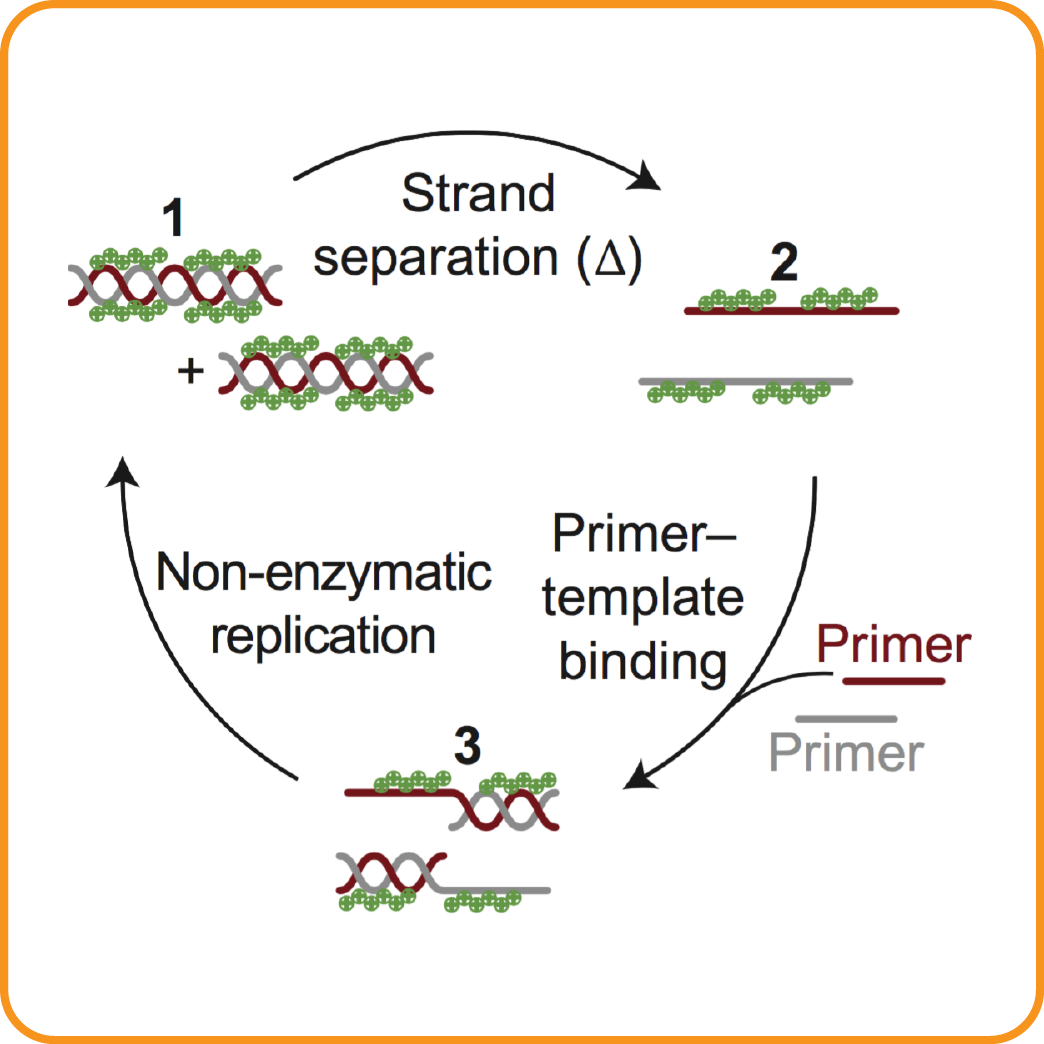
To enable repeated cycles of RNA replication, the two strands of the product must be separated and then copied before they reanneal. In solution, complementary RNA strands anneal orders of magnitude more rapidly than non-enzymatic template copying, rendering multiple rounds of RNA replication a formidable challenge. Our recent studies enabled further rounds of copying by using oligoarginine peptides. These peptides slow the annealing of complementary RNAs by up to several thousand-fold while still allowing short primers and activated monomers to bind to template strands. As a result template-directed primer extension can proceed even in the presence of the complementary strand to the template. Remarkably, the template copying occurs within a phase-separated condensed state, or coacervate. Future work will focus on elucidating the molecular mechanism of this unusual RNA-peptide interaction. |
 |
|
|
Read more... Oligoarginine peptides slow strand annealing and assist non-enzymatic RNA replication. |
|
|---|---|---|
|
Driving vesicle growth |
|
|
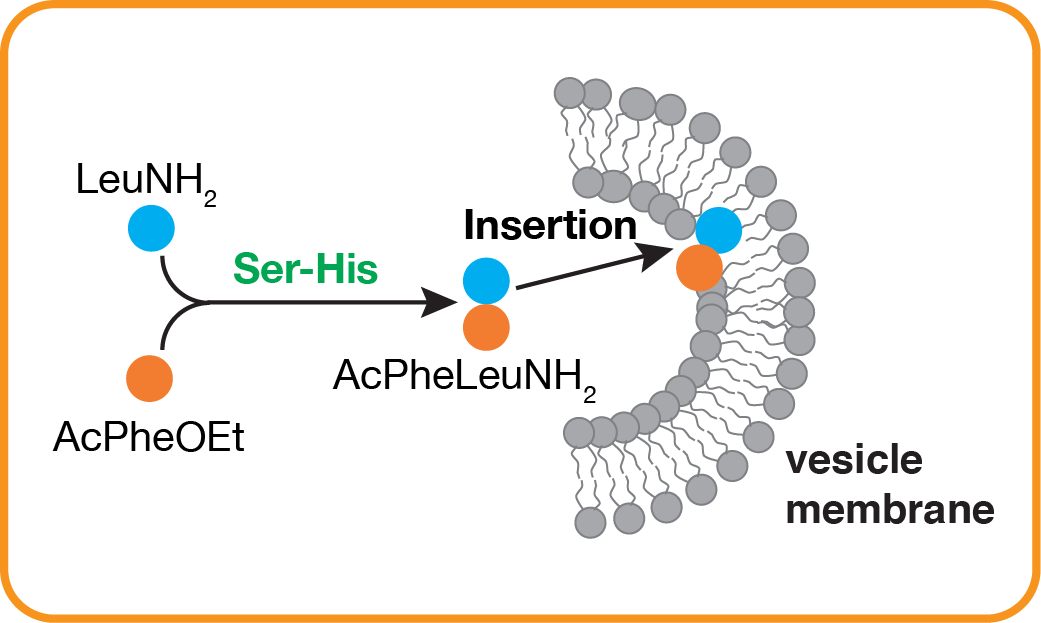
In addition to these structural roles, peptides can also play a
catalytic role in driving vesicle growth. We showed that a simple
dipeptide catalyst seryl-histidine (Ser-His) can drive vesicle growth
through the catalytic synthesis of a hydrophobic dipeptide,
N-acetyl-L-phenylalanine leucinamide, which localizes to the membrane
of model protocells and drives competitive vesicle growth in a manner
similar to that demonstrated previously for phospholipids. We are
currently exploring other simple peptide catalysts that could enable
the origin of selection and competition between protocells.
|
 |
|
Read more... Collaboration between primitive cell membranes and soluble catalysts. Competition between model protocells driven by an encapsulated catalyst. |
|
|---|---|---|
| || | research | || | people | || | publications | || | movies | || | resources | || | join | || |
© 2007 Szostak Lab |