 |
 |
 |
 |
 |
 |
 |
 |
 |
 |
 |
 |
||||||||||||||||||||||||||||||||||||||||||||||||||||||||||||||||
| Replicating vesicles | || | Chemical replication of nucleic acids | || | Peptides in prebiotic chemistry |
|
Chemical replication of nucleic acids |
||
|
Regiospecificity of chemical RNA copying |
|
|
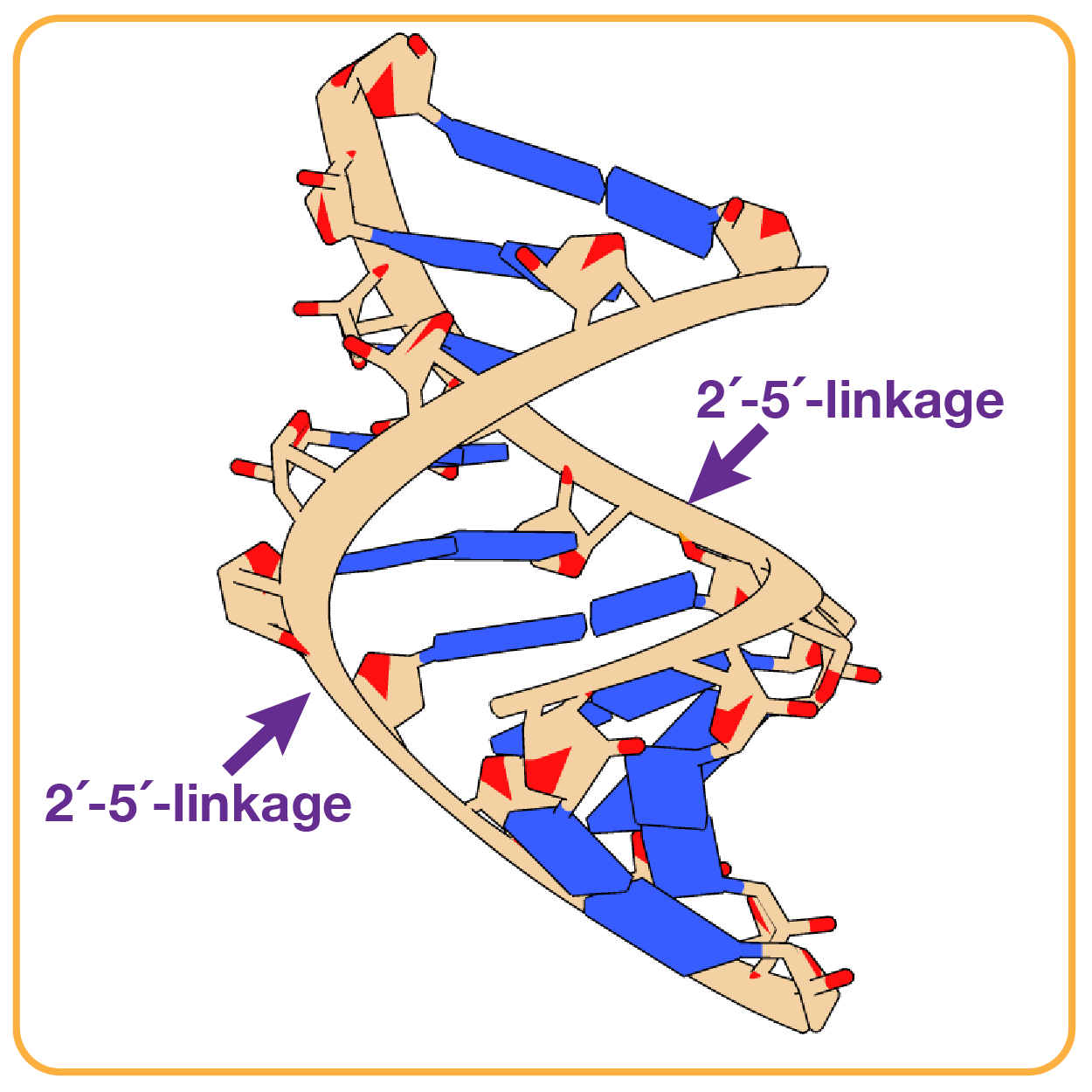
During the nonenzymatic copying of an RNA template by primer
extension, either the 2′ or the 3′ hydroxyl of the primer
can attack the phosphate of the incoming activated monomer, generating
either a 2′-5′- or a 3′-5′-linkage. The
resulting complementary strand will therefore contain a mixture of
2′-5′- and 3′-5′-linkages. Such backbone
heterogeneity was thought to disrupt the folding—and hence the
function—of RNA molecules. Our studies challenged this view and
showed that even in the presence of substantial backbone heterogeneity,
RNA aptamers and ribozymes can retain their molecular recognition and
catalytic functions. Our high-resolution crystal structures
rationalized this observation at the atomic level: RNA duplexes can
buffer local structural changes caused by 2′-5′-linkages,
resulting in a minimally altered global structure. Furthermore,
2′-5′-linkages reduce the energetic barriers of the ribose
pseudorotation cycle, allowing RNA molecules to sample a wider range of
conformations.
|
 |
|
Read more... A Mechanistic Explanation for the Regioselectivity of Nonenzymatic RNA Primer Extension. Unusual Base-Pairing Interactions in Monomer-Template Complexes. Functional RNAs exhibit tolerance for non-heritable 2'-5' versus 3'-5' backbone heterogeneity. Structural insights into the effects of 2'-5' linkages on the RNA duplex. The free energy landscape of pseudorotation in 3'-5' and 2'-5' linked nucleic acids. |
|
|---|---|---|
|
Fidelity |
||
|
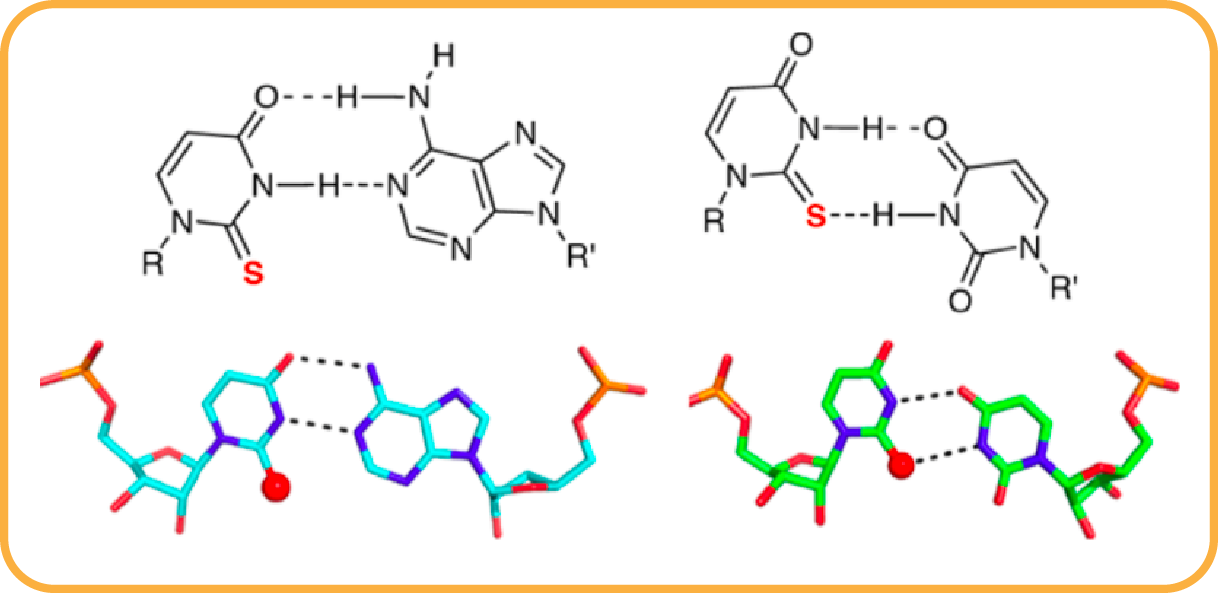
In order for protocells to have evolved in a Darwinian manner, the process of RNA replication must have been accurate enough to allow for the transmission of genetic information. This requires an error rate less than the reciprocal of the effective genome size, or about 1-2% for an RNA genome encoding 1 or 2 small ribozymes. Unfortunately, chemical copying using the four standard nucleobases is error-prone, and a major source of error is the G:U mismatch. Our recent studies showed that this problem can be alleviated by using s2U, a modified nucleotide that stabilizes canonical A:U pairs and destabilizes G:U wobble pairs. This single atom substitution improves both the kinetics and the fidelity of chemical copying of mixed-sequence RNA templates. We are actively exploring the potential roles of such noncanonical nucleotides during the infancy of the RNA world. |
 |
|
|
Read more... Fast and accurate nonenzymatic copying of an RNA-like synthetic genetic polymer. Crystal structure studies of RNA duplexes containing s(2)U:A and s(2)U:U base pairs. Thermodynamic insights into 2-thiouridine-enhanced RNA hybridization. |
|
|---|---|---|
|
Reaction mechanism |
|
|
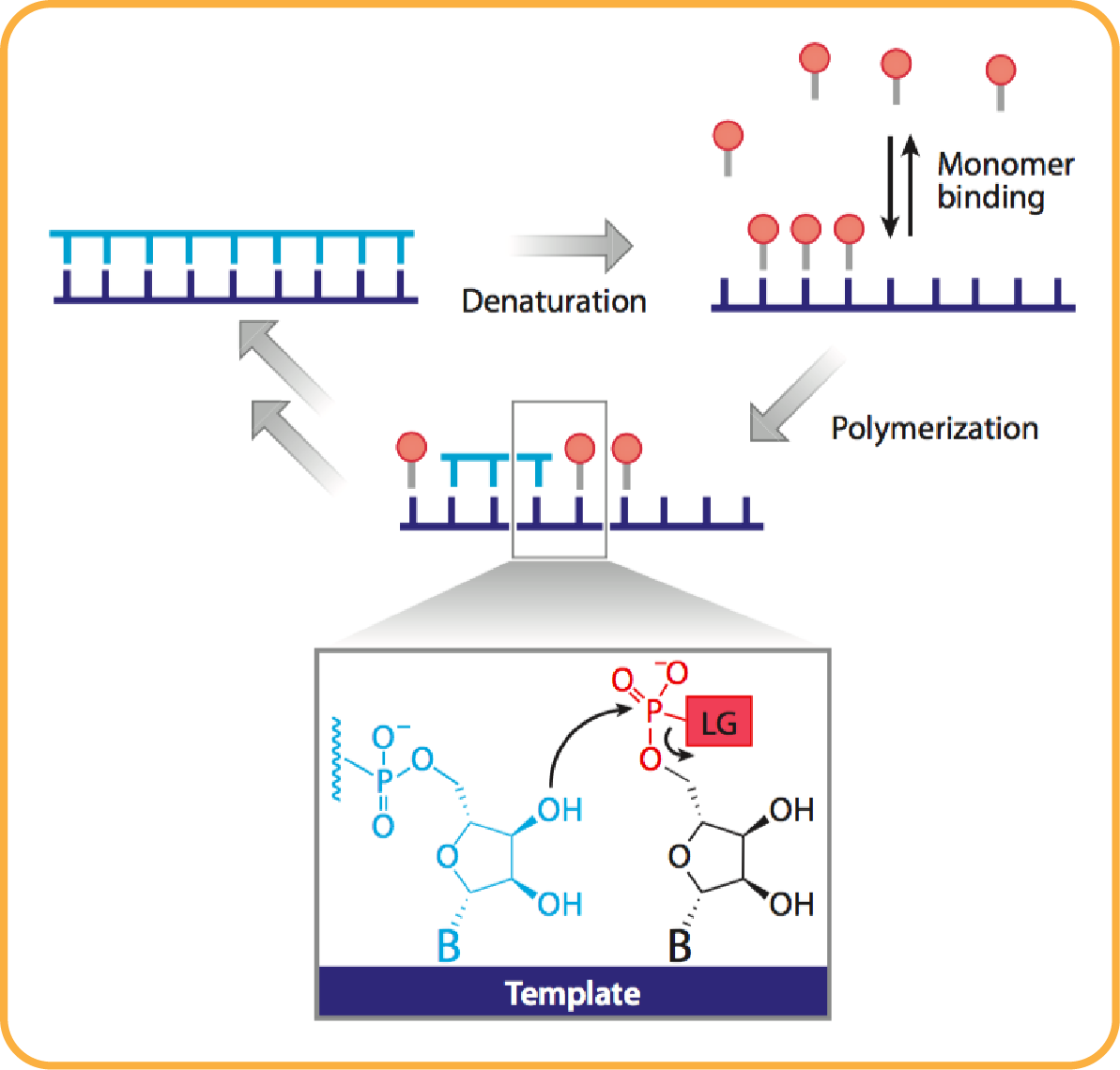
A mechanistic understanding of nonenzymatic RNA copying requires
detailed knowledge of the steps along the reaction pathway, including
the binding of the monomers to the template and the ensuing chemical
reaction that forms new phosphodiester bonds. Using NMR
techniques, we have measured the thermodynamic association constants
of nucleotide monophosphates to the template and probed conformations
of both free and bound activated monomers. The results showed that
RNA but not DNA templates induce conformational changes of the
activated monomers. The changes in the conformation of the monomers
increase their reactivity, and this explains why RNA templates are
superior to DNA templates for nonenzymatic primer extension.
Recently, we have obtained transition state models of the phosphoroimidazolide
hydrolysis reaction by combining quantum mechanical calculations with
experimental kinetic isotope effects and linear free energy relationships. The
experimental observations are best interpreted by a calculated SN2-like
concerted transition structure with extensive scissile bond fission. We are
now extending this line of research to understand how metal ions catalyze the
chemical step of the RNA copying reaction.
|
 |
|
Read more... Crystallographic observation of nonenzymatic RNA primer extension. A kinetic model of nonenzymatic RNA polymerization by cytidine-5'-phosphoro-2-aminoimidazolide. Enhanced Nonenzymatic RNA Copying with 2-Aminoimidazole Activated Nucleotides. Uncovering the thermodynamics of monomer binding for RNA replication. |
|
|---|---|---|
|
Activated helper oligos |
|
|
|
 |
|
Read more... |
|
|---|---|---|
|
Alternative genetic polymers |
|
|
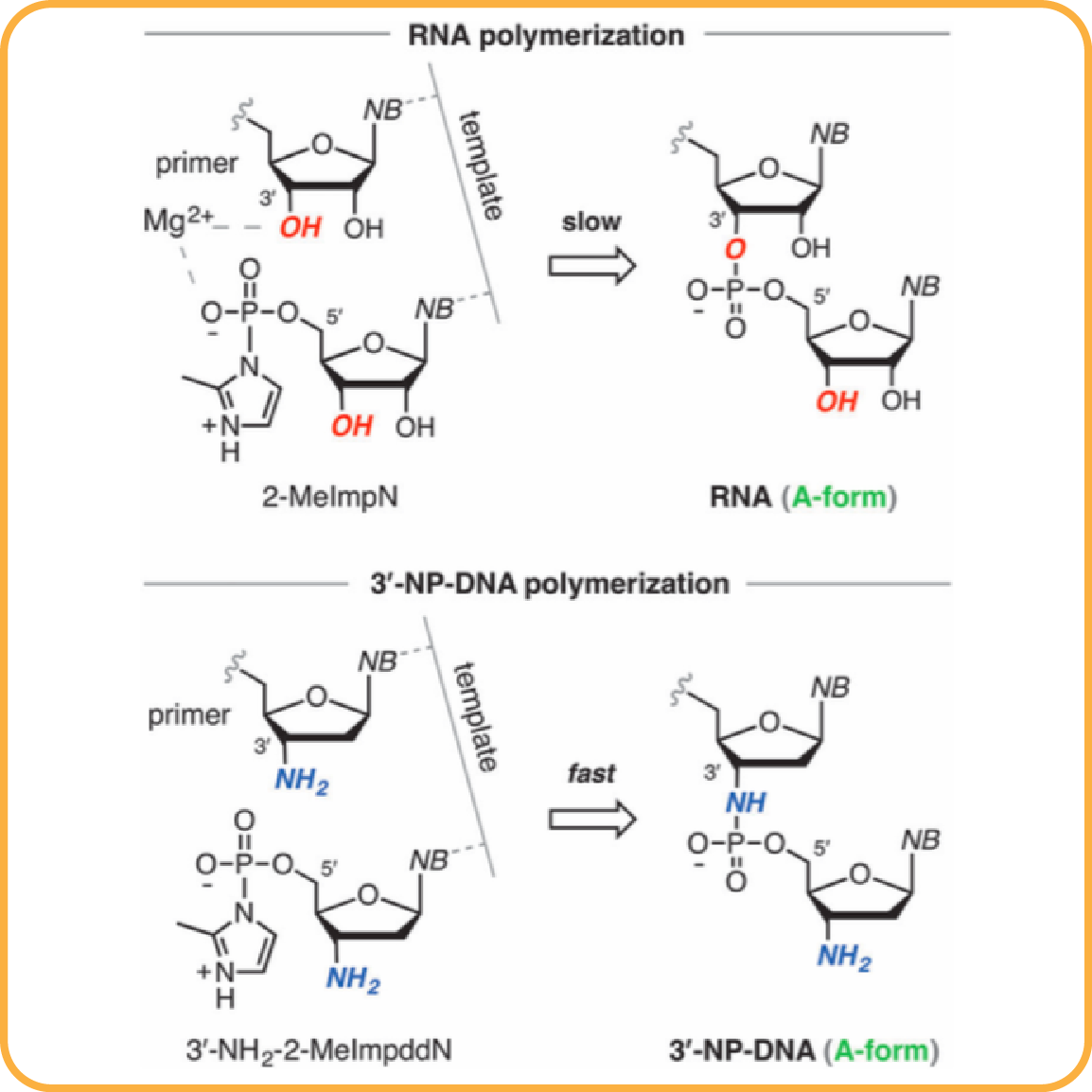
In addition to RNA, many alternative genetic polymers have been
proposed and some may have played a role in the early evolution of
life. Our lab has characterized an extensive array of such genetic
polymers, including threose nucleic acids, glycerol nucleic acids,
as well as ribonucleotides with 2′-amino or 3′-amino modifications.
Both 2′-amino-modified and 3′-amino-modified nucleotides are more
reactive than their hydroxyl counterparts, enabling rapid and
efficient copying of all four nucleobases on homopolymeric RNA and
DNA templates. Future investigations will focus on copying mixed
templates with all four nucleobases, within in fatty acid vesicles.
|
 |
|
Read more... Effect of terminal 3'-hydroxymethyl modification of an RNA primer on nonenzymatic primer extension. Synthesis and nonenzymatic template-directed polymerization of 2'-amino-2'-deoxythreose nucleotides. Fast and accurate nonenzymatic copying of an RNA-like synthetic genetic polymer. Synthesis of N3'-P5'-linked phosphoramidate DNA by nonenzymatic template-directed primer extension. Template-directed synthesis of a genetic polymer in a model protocell. |
|
|---|---|---|
| || | research | || | people | || | publications | || | movies | || | resources | || | join | || |
© 2016 Szostak Lab |