 |
 |
 |
 |
 |
 |
 |
 |
 |
 |
 |
 |
||||||||||||||||||||||||||||||||||||||||||||||||
| Replicating vesicles | || | Chemical replication of nucleic acids | || | Peptides in prebiotic chemistry |
|
Replicating vesicles |
||
|
Environmentally driven growth |
|
|
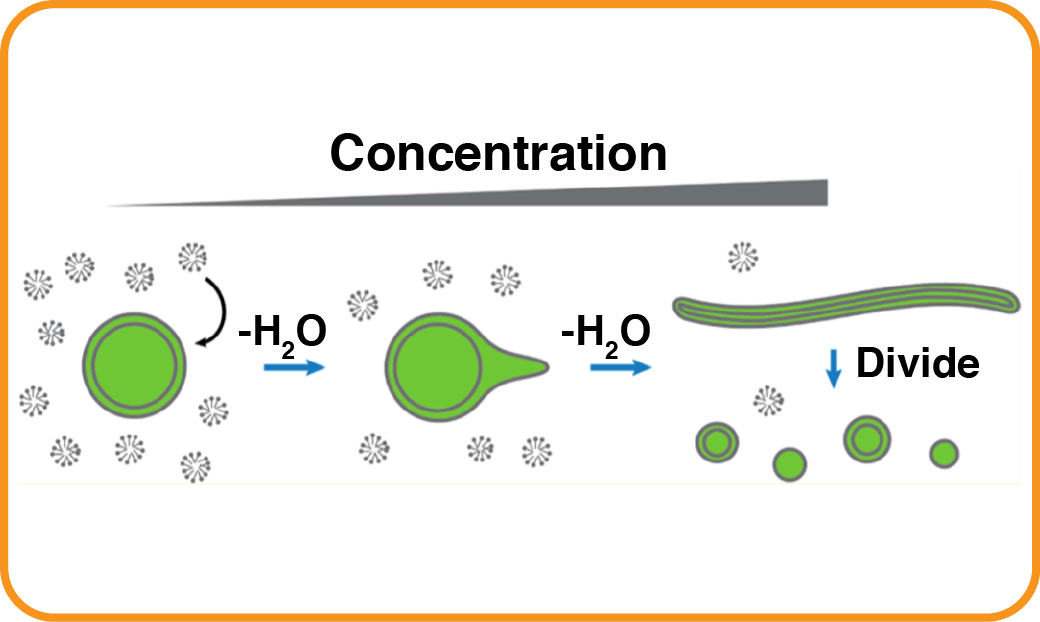
The first protocell membranes may have assembled from fatty acids
and related single-chain lipids available in the prebiotic
environment. At different concentrations, fatty acids can partition
between several different phases, including soluble monomers,
micelles, and lamellar vesicles, with higher concentrations favoring
larger vesicle aggregates. We have exploited this property to show
experimentally that evaporation can cause vesicles to grow by
increasing the total fatty acid concentration. Rainfall could then
cause turbulence and dilution, leading to the division of some
vesicles and the dissolution of others. Thus, alternation of
evaporation and rain could potentially lead to an environmentally
controlled cycle of growth and division.
|
 |
|
Read more... Concentration-driven growth of model protocell membranes. Coupled growth and division of model protocell membranes. Photochemically driven redox chemistry induces protocell membrane pearling and division. |
|
|---|---|---|
|
Phospholipid driven growth |
||
|
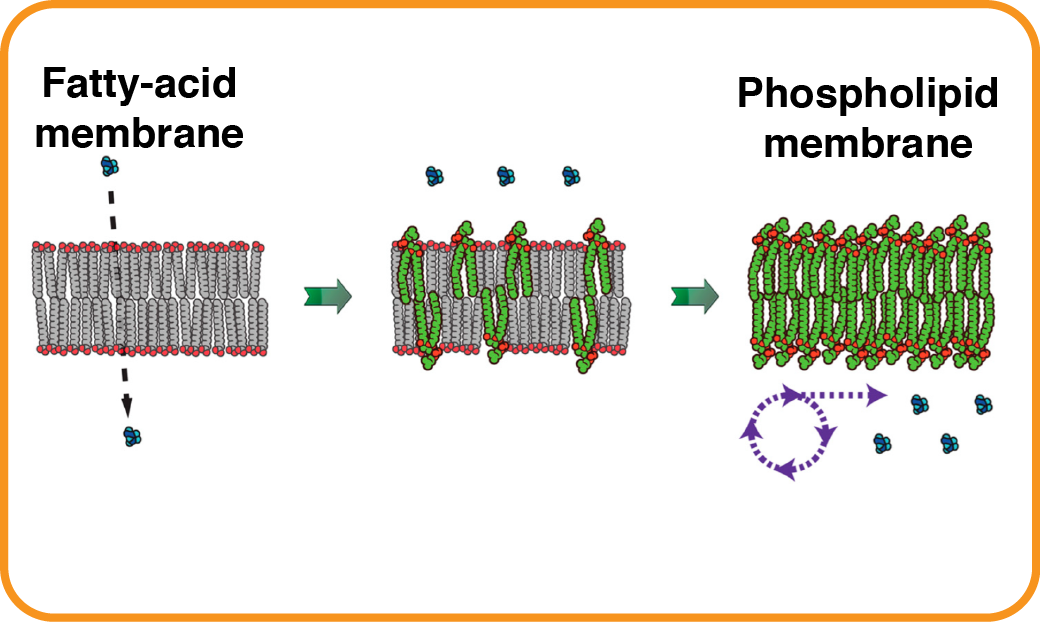
Vesicle growth can also occur as a result of competition between vesicles for limiting fatty acids. Recently we observed that vesicles that contain some phospholipid grow at the expense of vesicles that contain less phospholipid, suggesting the potential for an evolutionary arms race leading to the synthesis of ever increasing levels of phospholipid. Since this would eventually lead to altered membrane properties including decreased permeability, it is possible that the evolution of phospholipid synthesis set the stage for such downstream events as the evolution of metabolism and membrane transport machinery. |
 |
|
|
Read more... Physical effects underlying the transition from primitive to modern cell membranes. |
|
|---|---|---|
|
Integration with RNA copying |
|
|
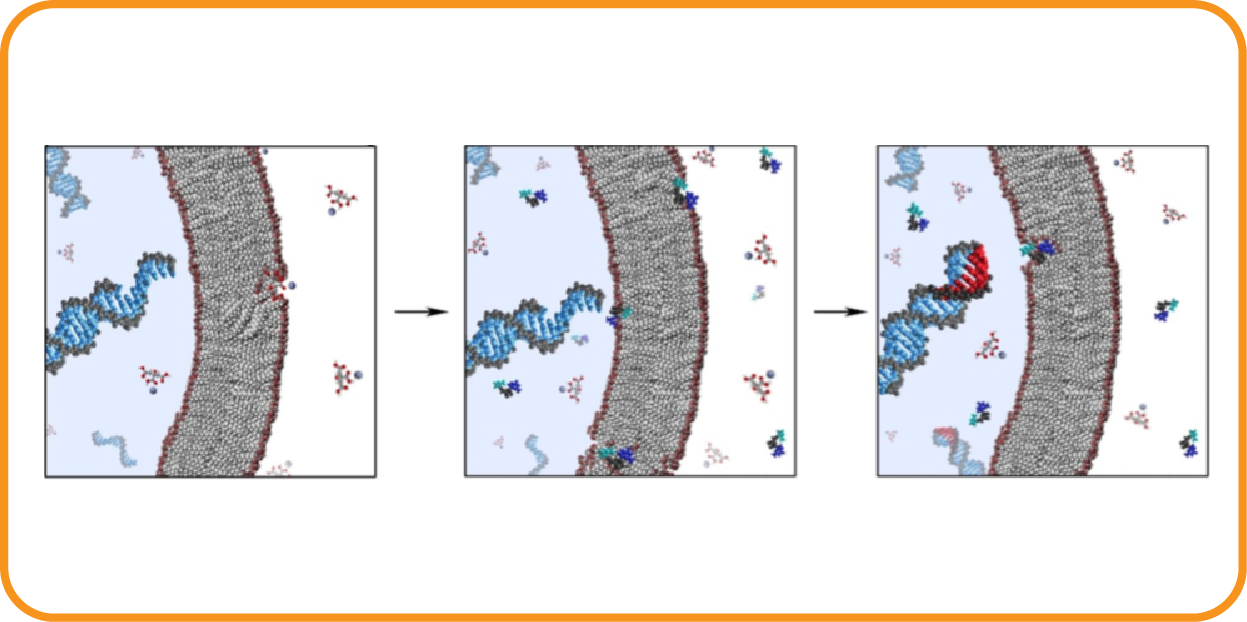
For many years there appeared to be a fundamental incompatibility
between RNA replication, which requires high levels of
Mg2+, and fatty acid membranes, which are destroyed by
moderate levels of Mg2+. However, we recently found that
when Mg2+ ions are chelated by citrate, membranes are protected but
RNA copying can still proceed. This allowed us to carry out
RNA-copying reactions within fatty acid vesicles by adding activated
nucleotides to the outside of vesicles that contained encapsulated
primer-template complexes. In addition to being a major step toward
the synthesis of a complete protocell, this experiment is
significant because it shows that early protocells could have been
heterotrophs that grew by taking up nutrients such as nucleotides
that were synthesized in the external environment.
|
 |
|
Read more... Copying of Mixed-Sequence RNA Templates inside Model Protocells. Nonenzymatic template-directed RNA synthesis inside model protocells. |
|
|---|---|---|
| || | research | || | people | || | publications | || | movies | || | resources | || | join | || |
© 2016 Szostak Lab |